
Poster 01
Resilient Learning Analytics for Student Success Prediction in Developing Countries
Yann Brondon Foka Maghen
University of Douala, Cameroon
Ten papers and five posters exploring how AI can serve engineering education, agriculture, health, transport and quality assurance in resource-constrained environments.

Presentation of the forum, committees, full schedule, keynote abstracts, panels, contributions and posters. PDF · 1.3 MB · 23 pages.
Download the PDFAwards
The awards were presented during the closing ceremony on Thursday 11 June 2026.
Two prizes rewarded the most outstanding contributions presented during the oral sessions and the poster session.
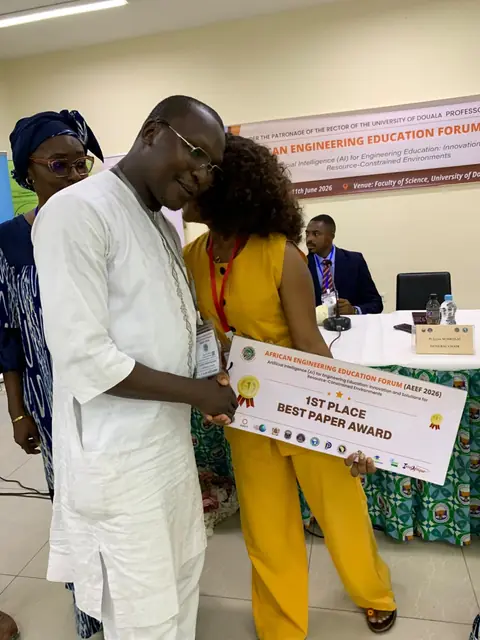
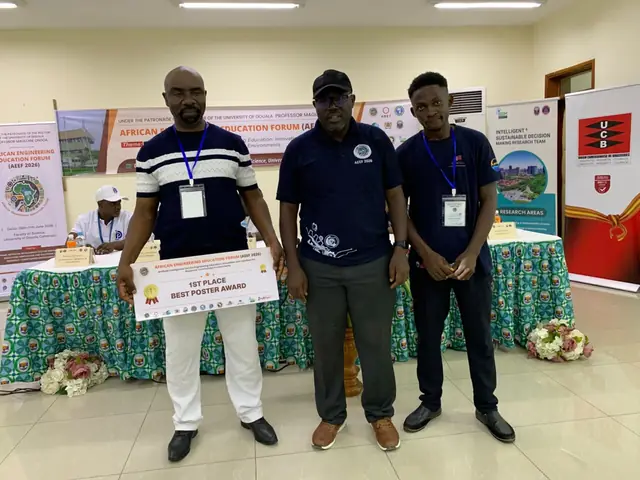
Contributions
Abstract — In developing countries, engineering education faces a structural crisis characterized by a widening gap between academic curricula and labor market needs. Traditional revision processes, hindered by administrative inertia and a lack of real-time data, fail to keep pace with rapid technological shifts. To address this issue, this paper proposes a self-evolving curricular framework based on Reinforcement Learning (RL). The academic program is modeled as a sequential decision-making process that dynamically adjusts pedagogical structures through a multi-criteria reward function integrating employability trends, academic performance, and industrial alignment. Simulation results demonstrate a 45% improvement in skills-to-market fit and a projected 35% increase in employability. This model establishes a sustainable, data-driven mechanism for modern academic governance.
Abstract — Limited internet connectivity continues to constrain access to digital learning resources across many low- and middle-income countries, particularly in Sub-Saharan Africa. This paper presents Malloum, an SMS-based generative AI tutoring system designed to deliver contextualized, curriculum-aligned pedagogical support in low-connectivity environments. Students submit academic questions via standard SMS to a dedicated short code. A hierarchical prompt architecture combines a pedagogical role definition, curriculum injection aligned with the Cameroonian national syllabus and the user query, enriched by an educational database of validated exam banks and student profiles. The platform implements structured micro-explanations, compression, automatic message concatenation and adaptive bilingual output (French/English). An evaluation with 1,000 secondary school students in the Far North Region of Cameroon shows an average improvement of 40% in academic performance (pre-test/post-test design).
Abstract — The appropriation of mobile digital tools and Artificial Intelligence in secondary education is a significant lever for transforming teaching practices and developing professional skills, yet their appropriation by teachers remains limited. This study analyzes the factors influencing the appropriation of mobile digital tools and AI by secondary school teachers in Cameroon, using a quantitative approach with 261 teachers and structural equation modeling. Ease of use, compatibility, usefulness and social influence significantly influence appropriation, while pleasure and relief are the emotional dimensions that reinforce it. Emotional and contextual dimensions should therefore be integrated into teacher training and support policies.
Abstract — Digital learning platforms deployed across Sub-Saharan Africa predominantly rely on monolithic LMS architectures that cannot accommodate the cognitive, linguistic and infrastructural diversity of learners; across six African institutions, effective LMS utilisation does not exceed 29% of enrolment. This paper proposes an autonomous adaptive hypermedia architecture grounded in the Munich Reference Meta-Model, whose Open Dynamic Learner Model runs a Deep Knowledge Tracing engine in Edge AI mode for asynchronous personalisation in degraded connectivity. Evaluated on the OULAD dataset: accuracy degradation below 5 pp under 60% connectivity dropout, a 65.93% MAE reduction in engagement prediction through cluster-based adaptation, and AUC-ROC = 0.79 for the LSTM-DKT mastery predictor — a reproducible baseline before field validation in partner universities.
Abstract — This study introduces a hybrid architecture for automated cough sound analysis combining unsupervised detection with supervised classification: a one-class SVM isolates cough events from raw audio without labeled data, and a CNN classifies them into three clinically relevant categories. MFCCs enriched with temporal derivatives, standardization and dimensionality alignment ensure an accurate spectral and temporal representation. The framework reaches 93% accuracy and an F1-score of 0.91, remaining robust on noisy, heterogeneous data. Beyond clinical relevance, it is a practical case study for engineering education, integrating signal processing, machine learning and system design in one coherent pipeline.
Abstract — Maize is a vital staple crop for food security in Sub-Saharan Africa; in Cameroon, an annual deficit of 600,000 tonnes is heavily affected by diseases such as Maize Lethal Necrosis (MLN) and Maize Streak Virus (MSV). Using the open-source Lacuna Maize Dataset (15,349 field images), the authors fine-tune a pretrained ResNet50 with a class-weighted cross-entropy loss. The model achieves 98% accuracy on an independent test set of 1,536 images, with per-class F1-scores of 0.99 (healthy), 0.97 (MLN) and 0.98 (MSV), and is deployed in a web application with an interactive chatbot providing real-time predictions and early warnings.
Abstract — Fuel overconsumption increases operating costs, environmental impacts and maintenance requirements in resource-constrained transport systems. This study proposes an explainable ANFIS-PSO framework predicting vehicle fuel consumption from real-world engine and contextual data collected in Douala through an embedded OBD-II acquisition system. Compared with standard ANFIS, Random Forest, XGBoost and an MLP, ANFIS-PSO performs best (R² = 0.97146). Interpretable fuzzy rules combined with SHAP-based feature analysis identify the operating conditions behind high consumption, helping maintenance engineers prioritize inspections.
Abstract — Continental prosperity is the vision of an economically integrated, developed, and stable continent. Engineering education is a catalyst for change: it promotes national and regional prosperity by developing skills to create innovative products and processes, drive economic growth, solve societal challenges sustainably, and foster technological advancement. Africa can achieve immense prosperity through engineering education if member nations make strategic investments in engineering capacity and infrastructure. AI plays a crucial role by enhancing education systems, shaping the future workforce and stimulating innovation.
Abstract — The digital transformation of higher education has exposed fundamental limitations in traditional quality assurance systems within outcome-based education frameworks, which rely on input-based proxies such as infrastructure and contact time that poorly represent digitally mediated learning. This misalignment is especially pronounced in resource-constrained African environments, where institutions must meet global accreditation standards despite constraints. While African universities adopt AI and learning analytics for student support, these data-rich practices remain weakly integrated into formal QA and accreditation processes — the gap this functional equivalence framework addresses.
Abstract — Aerospace engineering education in emerging economies is often trapped in a “resource mirage”, replicating heavily funded Western laboratory models within fiscally constrained environments. This study proposes a Dual-Stream Agile Framework shifting pedagogical focus from “molecular” course structures to “atomic” isomorphic mapping, with Generative AI as a technical catalyst. A structural alignment analysis and a modified Delphi study with aerospace experts show strong consensus on industrial relevance (µ = 4.39/5) and academic rigor (µ = 4.22/5), offering a resource-agnostic road-map for engineering excellence in African universities.
Poster session · Thu 11 June
Poster 01
Yann Brondon Foka Maghen
University of Douala, Cameroon
Poster 02
Tchakam Duplex Cédric
University of Douala, Cameroon
Poster 03
Patrice Tchana Minji
Poster 04
Azongo Neilla Audrey
ISSEA, Yaoundé, Cameroon
Poster 05
Leslie Erika Kouamouo Ndangang
University of Douala, Cameroon
No paper or poster matches your search.